Key Takeaways
- A single source of truth means one trusted, central place for your business data.
- Disconnected systems create conflicting numbers and slow, uncertain decisions.
- Centralizing data in a cloud warehouse is the foundation of any reliable SSOT.
- Clear data ownership and governance keep your single source of truth accurate over time.
What a Single Source of Truth Actually Means
A single source of truth, often shortened to SSOT, is the practice of storing a piece of information in exactly one place, so every team and every report pulls from that same trusted source. It sounds simple, but in practice, most businesses end up with the opposite. Sales numbers live in a CRM. Finance keeps its own spreadsheet. Marketing tracks performance in yet another platform. When someone finally compares the three, the numbers rarely match.
This is technically known as the single version of the truth concept in data warehousing, which describes the ideal of having either a single centralized database or a distributed, synchronized one that stores all of an organization’s data in a consistent, non redundant form. The goal is not just accuracy. It is confidence. When everyone trusts the same numbers, decisions move faster.
Why Most Businesses Struggle With This
Canada’s small business sector is the backbone of the economy, with small businesses accounting for over 98% of all employer enterprises, according to the Government of Canada’s Key Small Business Statistics 2025. Yet most of these businesses grow their tools and systems organically, adding a new app whenever a new need arises. Over a few years, that approach naturally creates the very data silos that make a single source of truth so difficult to achieve.
Several common patterns tend to drive this problem:
- Different departments adopt different software without coordinating with the rest of the business.
- Spreadsheets get used as a quick fix, then become permanent, undocumented sources of critical numbers.
- Nobody is formally responsible for deciding which system holds the official version of a given metric.
- Reports are built manually each time, recreating the same inconsistencies again and again.
The Real Cost of Not Having One
The cost of fragmented data is rarely obvious until you measure it directly. Teams spend hours each week reconciling numbers instead of acting on them. Decisions get delayed while people debate whose spreadsheet is correct. Metadata fragmentation and the absence of a single source of truth across multiple tools force data teams to spend more time being glue code developers than actually building anything useful.
Beyond the time cost, there is a trust cost. Once leadership stops trusting the numbers in front of them, every report becomes a debate rather than a decision point. That erosion of confidence is often more damaging than the inefficiency itself.
Step One: Centralize Your Data in One Place
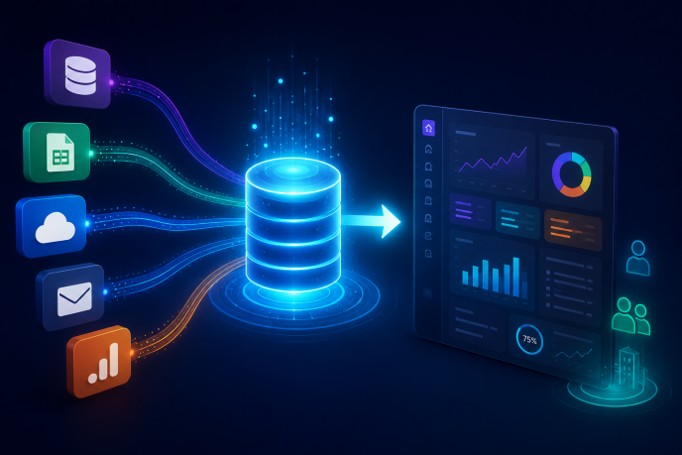
The foundation of any single source of truth is a central cloud data warehouse. This is where data from your various systems, your CRM, your finance software, your marketing platforms, gets pulled together into one location. A 2026 benchmark report on the modern data stack landscape specifically recommends using your data warehouse as your single source of truth, since it gives every downstream tool, dashboard, and report a consistent starting point.
Data engineering work at Data Solutions Consulting focuses heavily on this exact step, building reliable pipelines that move data into a central warehouse without losing accuracy or freshness along the way.
Step Two: Define Clear Ownership for Each Data Set
Centralizing your data solves half the problem. The other half is making sure everyone agrees on which version is official once it gets there. This is where data governance becomes essential. Effective data governance establishes clear accountability, consistent definitions, and processes that ensure data remains accurate, secure, and trustworthy across the business.
- Assign a Data Owner: Someone accountable for the accuracy and definition of each key metric, whether that is revenue, customer count, or churn.
- Document Definitions Clearly: A metric like ‘active customer’ needs one agreed upon definition, written down and shared, not interpreted differently by each department.
- Establish Update Rules: Decide who can edit source data, when updates happen, and how changes are tracked.
Step Three: Standardize Your Transformation Logic
Raw data rarely arrives ready for use. It needs to be cleaned, standardized, and shaped consistently before it becomes trustworthy. This is where transformation tools come in, applying the same business logic every time data flows through the system rather than relying on someone manually adjusting numbers in a spreadsheet. Defining business logic once, in code, and testing it consistently is what makes data trustworthy enough for both human decision makers and increasingly, AI systems.
This step is often where businesses see the biggest jump in trust. When the same calculation runs identically every single time, the room for human error and inconsistent definitions disappears.
Step Four: Build Dashboards That Pull From One Source
Once your data is centralized and properly transformed, the final step is making sure every dashboard and report draws from that same source rather than recreating its own version. This is the visible part of a single source of truth, the part your team actually interacts with daily.
- Connect all dashboards directly to your central warehouse, not to individual source systems.
- Retire legacy spreadsheets and manual reports once your centralized dashboards are validated and trusted.
- Set a regular review cadence to confirm dashboards remain accurate as your business evolves.
Why This Matters More as Businesses Adopt AI
A single source of truth is no longer just a nice to have, particularly as more organizations explore AI driven tools. AI adoption among Canadian firms doubled between 2024 and 2025, yet the value of those tools depends entirely on the quality and consistency of the data feeding them. An AI system pulling from fragmented, conflicting data sources will simply produce fragmented, conflicting answers.
Recent industry commentary on AI agents reinforces the same point: agents querying stale or siloed systems do not just produce wrong answers, they take wrong actions. A governed single source of truth is what allows AI tools to be trusted with real business decisions rather than treated as a novelty.
Common Mistakes to Avoid
Building a single source of truth is a process, not a one time project. A few mistakes tend to derail businesses along the way:
- Trying to Centralize Everything at Once: Start with your highest priority metrics rather than attempting a full overhaul immediately.
- Skipping Documentation: Without clear, written definitions, teams will eventually drift back into disagreement over what a number actually means.
- Leaving Legacy Spreadsheets Running in Parallel: If old reports are not retired, people will quietly keep using them, undermining the new system.
- Treating It As Purely Technical: A single source of truth requires organizational buy in and clear ownership, not just the right software.
Conclusion
A single source of truth changes how your business makes decisions, replacing debate and confusion with confidence and speed. It takes the right foundation, clear ownership, and consistent logic to get there, but the payoff is significant. If you are ready to stop reconciling spreadsheets and start trusting your numbers, contact us today. We would be glad to help you build a system you can rely on.
FAQs:
What is a single source of truth in business terms?
A single source of truth is one trusted, central location for business data, ensuring that every team, dashboard, and report uses the same accurate and consistent information.
How long does it take to build a single source of truth?
Most businesses can establish a functional core system within a few weeks, although achieving full adoption and integration across all departments may take longer.
What is the difference between a single source of truth and a data warehouse?
A data warehouse is the technology and storage layer that centralizes data, while a single source of truth is the broader practice of using that centralized data as the trusted and authoritative source for business decisions.
Do small businesses need a single source of truth?
Yes. As businesses grow and adopt more systems, inconsistent data can create confusion and inefficiencies. A single source of truth helps maintain accuracy and alignment across teams.
Why do businesses end up with multiple versions of the same data?
Businesses often adopt different tools and platforms over time, resulting in disconnected systems that each store their own version of important metrics and information.
Can a single source of truth support AI tools?
Yes. AI tools rely on accurate, consistent, and well-structured data. A single source of truth provides the reliable foundation needed to improve AI performance and support data-driven decision-making.